
What Is Association Management Software? a Practical Guide
What is association management software? See how it handles member records, dues, events and communication for US associations and clubs.

A membership coordinator opens three files to answer one question. Has Jordan Lee renewed, paid, and registered for the annual meeting? The dues spreadsheet says one thing, the event sign-up sheet says another, and the email list is six months old. Staff and volunteers inherit that mess every time a treasurer or board seat changes hands.
Association management software exists to stop that scavenger hunt. It is the system of record that keeps the member, the payment, and the activity on one shared record.
What Association Management Software Means
Association management software (AMS) is a system of record for membership organizations. It keeps member records, membership dues, events, communication, and member self-service in one place, instead of scattering them across spreadsheets, payment tools, event platforms, and email databases.
One member, one record, many activities.
Think of a shared filing cabinet with one index card per member. Every authorized person updates that same card. You are not hunting through a shoebox of receipts, a paper sign-up sheet, and a separate email list. When someone asks whether a member is current, paid, and registered, you open one record.

The ASAE technology toolkit describes AMS technology as optimized for professional societies and trade associations, with centralized data, process tracking, and a fuller view of each constituent. Typical work on that record includes individual and company profiles, membership status and duration, dues, event participation, purchases, and certification activity. Staff can connect a renewal history with attendance and purchases without opening separate files. That coordination matters most when programs multiply, volunteer leaders rotate, or staff turn over, because the organizational record no longer lives in one person's folder.
Membership management software is the broader category, and it covers clubs as well as associations. AMS is the name associations use for that same idea. Professional and trade associations, sports and recreation clubs, membership-based nonprofits, arts and cultural organizations, and volunteer-led groups all rely on it when recurring dues and programs outgrow a contact list. campai is membership management software that manages members, dues, events, communication, finances, donations, and the Community App in one place.
The Core Capabilities Every AMS Covers
An AMS is not a fancy address book. Each capability below should write back to the same member, so a treasurer and an event coordinator are not maintaining twin lists.
| Capability | What It Tracks | Question It Answers |
|---|---|---|
| Member database | Contact details, membership level, status and history | Who is an active member today? |
| Dues and billing | Dues amounts, invoices, online payments and payment status | Who has an unpaid balance? |
| Renewals | Renewal dates, reminders and lapsed memberships | Who needs to renew this month? |
| Event registration | Registrations, attendance and bookings | Who attended last year's annual meeting? |
| Communication | Email lists, opt-out preferences and message history | Who should receive this newsletter? |
| Member self-service | Profile updates, dues payments and event sign-ups | Can members update their own details without calling the office? |
| Donations | Gifts, acknowledgments and donor history | Who gave this year and has been thanked? |
What each row is for
The member database holds contact details, membership levels, status, and history. It answers who is active today, including whether the record is an individual or a company.
Dues and billing stores amounts, invoices, online payments, and payment status. The treasurer's question is simple: who still has an unpaid balance? Renewals add dates, reminders, and lapsed memberships, so the coordinator can see who is due this month without rebuilding a list.
Event registration records sign-ups, attendance, and bookings. Last year's annual meeting is on the member, not on a leftover spreadsheet. Communication keeps email lists, opt-out preferences, and message history, so a newsletter goes to people who should receive it and skips people who opted out.
Member self-service, often through a member portal, lets members update details, pay dues, and register. That cuts the "please change my phone number" calls. Donations are voluntary gifts, not dues. The record shows who gave this year and whether an acknowledgment went out.
One record underneath the rows
These rows share one member record. A renewal reminder can reflect event attendance. A treasurer can see a payment without a second lookup. The ASAE toolkit on AMS design treats an AMS as a specialized system of record that links a person or organization to membership category, dues status, renewal history, attendance, purchases, certifications, committees, and communications. ASAE recommends that single source of truth, while specialized systems can still sit alongside it. The practical requirement is a canonical member ID and clear ownership of core fields. Without that, spreadsheets create duplicates, inconsistent eligibility, and unreliable renewal reporting.
Practical rule: If a feature writes to a separate list instead of the member record, it is not doing the job of an AMS.
How a Member Moves Through the System
Follow one person from application to the next renewal. Each step has an owner, and each step updates the same record.
- A prospective member submits a membership application online, and the member database creates the record. Owner: membership coordinator.
- The coordinator reviews the application and assigns a membership level, such as individual, student, or business. Owner: membership coordinator.
- The treasurer confirms the dues for that level. The member receives an invoice or a payment link. Owner: treasurer.
- Payment status updates the record. Reminders go to members with unpaid dues, including a note when an online payment is returned. Owner: treasurer.
- The member registers for the annual meeting, and that registration attaches to the same record. Owner: event coordinator.
- The member updates a phone number through member self-service, so the next mailing uses current details. Owner: the member.
- Before the renewal date, reminders go out. The coordinator reviews who has not renewed and plans outreach. Owner: membership coordinator.
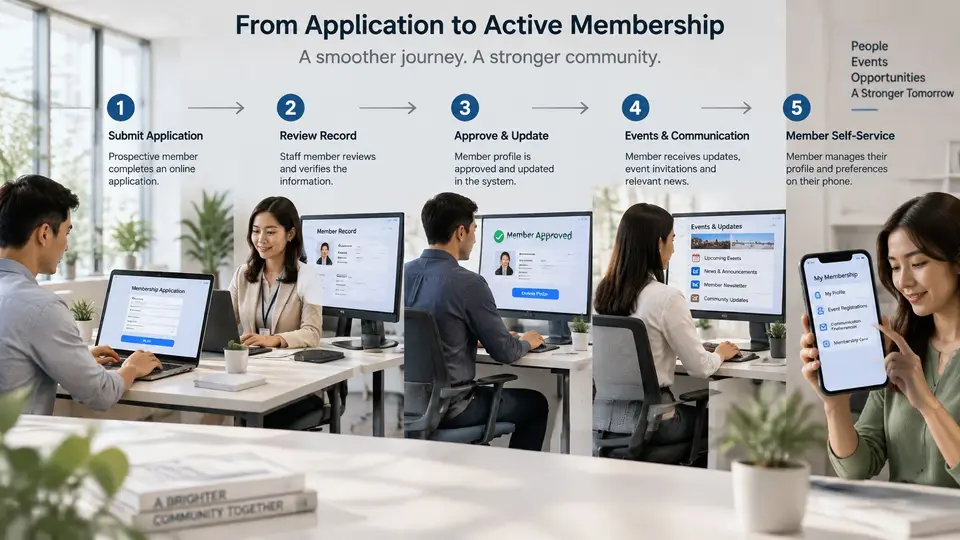
Say a regional trade association sets a $150 annual dues level. That figure is a hypothetical example, not a published price. The treasurer checks one member record for payment status instead of three spreadsheets. For associations, campai connects member records, dues, events, and communication so a team can follow a membership from application to renewal. It can assign dues, send welcome emails with digital member IDs, and link family members without duplicate records.
At the end of the cycle, the coordinator reviews non-renewals, decides whom to contact first, and records each outreach attempt on that same member record. The next person who inherits the role can see what was already tried.
Which Organizations Use an AMS and Why
The shape of the record changes with the organization. The question the staff need answered does not.
A state trade association. Picture about 1,200 members, firm and individual levels, and a yearly conference. Renewal timing slips because the event list and the dues list don't match. The team needs one contact per member, with firm and membership level attached. The question: which firms have not renewed before the conference?
A tennis club. Family memberships and court bookings mean one household should not become four unrelated rows. The question: which household members have paid dues and booked courts this season? Clubs need membership, dues, bookings, and group messages to stay organized between get-togethers.
A community arts nonprofit. Volunteers, donors, and program enrollments often live on three lists that nobody reconciles. Shared records replace those lists. The question: which volunteers also made a gift this year? Nonprofits need members, volunteers, donors, and programs together, with a named owner for each list that used to stand alone.
A volunteer-led hobby club. About 80 members, and one treasurer inherits a spreadsheet every January. The useful record is one row per member with dues status and payment date. The question: who paid last season, and who still owes?
Renewal outreach needs a current record
Member retention is an operations problem, not only a marketing slogan. In an ASAE Pulse Poll, 31.9% of association leaders named membership retention and engagement their top challenge. The poll went to 4,611 association and association-management-company leaders at director level or above and drew 257 responses, a response rate of just over 5%. Outreach works when staff can see current contact details, membership levels, renewal dates, participation history, and communications together, then decide who may lapse and when to reach out.
AMS Compared With Other Systems You May Hear About
The acronym trips people up. Four different things get called "management systems," and only one of them runs membership.
| System Type | Main Purpose | Who Operates It | Typical Fit |
|---|---|---|---|
| Association management software (AMS) | Runs member records, dues, events and communication | Association staff and volunteers | Membership organizations that collect recurring dues |
| Association management company (AMC) | Provides outsourced staff and administration for an association | The management firm's own staff | Associations that outsource day-to-day operations |
| General CRM | Tracks leads, contacts and sales pipelines | Sales or marketing teams | Sponsor and prospect sales, with limited membership rules |
| Automotive management system | Runs dealership or repair-shop work such as inventory and service orders | Automotive business staff | Not designed for membership records |
An AMS is software. Your staff and volunteers use it to run records, dues, events, and communication. An association management company (AMC) is an outside firm. Its employees staff the association's administration, and that firm may use an AMS as one tool among others. Hiring an AMC is not the same decision as buying software.
A general customer relationship management (CRM) system tracks leads, contacts, and sales pipelines. A sponsorship team may want that. It usually does not carry membership levels, dues status, or renewal rules unless someone builds them by hand. An association can keep a CRM for sponsor sales and an AMS for members. They can sit side by side.
An automotive management system runs dealership or repair-shop work, such as inventory and service orders. A web search for "AMS" will surface it. It does not keep membership records.
A quick test for the board
Ask whether the tool tracks membership levels, dues status, and renewal dates. If it does, it belongs in the AMS category. Three follow-up questions sort the rest:
- Who does the work? Your volunteers, or a management firm's staff?
- What is the object? A member with a renewal date, or a sales lead?
- Would a repair shop recognize this screen? If yes, you are in the wrong product family.
Limits, Data Controls and Common Misconceptions
A unified database cuts duplicate entry. It also concentrates risk. One bad import, one oversized administrator login, or one poorly connected integration can touch the entire member list.
The same record that answers every operational question can expose every answer at once. That trade-off is why controls matter more after consolidation than they did when data sat scattered across spreadsheets.
Member data in the sector is widely reachable, and protection practices lag behind that reach. The 2025 NTEN nonprofit data report found that nearly 92% of surveyed nonprofits use cloud-hosted databases and almost 90% have staff entering data directly, while only 31% report a custom data-protection policy that is regularly reviewed, trained, or clearly explained to staff. A written policy, reviewed on a cycle the board sets, fills the gap that tooling leaves open.
Before you move member data onto one platform, require these controls:
- Role-based permissions: Each person sees only what the job needs.
- Approval workflows: Changes to dues and membership levels need a second set of eyes.
- Audit trails: You can see who changed a record and when.
- Export controls: Few people can download the full member list.
- Offboarding: Access ends when a board member, volunteer, or contractor leaves.
- Consent records: Communication preferences stay on the member.
- Retention rules: Old records are kept or removed on a schedule the board sets.
- A written split of responsibility: The provider runs the platform. The association owns the data, the permissions, and the decisions.
Three misconceptions linger, and they share one root: software enforces the rules you configure, while the board decides what those rules are. Security comes from permissions, reviews, and habits around the platform, a single database concentrates risk into fewer places rather than removing it, and feature lists vary by plan, so confirm the capabilities you need before you buy.
Smaller associations that rely on volunteers and have no dedicated IT staff should name one owner for permissions and review them on a schedule the board chooses. These practices cover daily operations. Questions about legal obligations belong with qualified counsel.
Confirm Whether an AMS Fits Your Organization
Fit comes down to five questions. Write the answers down and share them with the board before anyone sits through a demo.
- How many members and membership levels do you manage? Several levels, company memberships, or family records point toward a system. One flat list of names may not.
- How many people update member records each month? If more than one person edits, you need permissions and a shared record. A single careful editor can still get by on a spreadsheet.
- Do members need self-service for profile updates, dues, and event sign-ups? If members call the office for every change, a portal saves time. If they rarely interact online, self-service can wait.
- How many spreadsheets and separate tools would one system replace? Replacing dues, events, and email lists together is a strong fit. Replacing a single sign-up sheet is a weak one.
- Who will own dues settings, applications, and permissions? If nobody will own them, the software drifts back into side lists.
That last question is where the software stops and the association's own governance begins. A workable split looks like this. The treasurer owns dues settings. The membership coordinator owns applications and renewals. The board approves permission levels on a review cycle it chooses. A very small group with one person and one list may not need a full system yet.
Read your five answers against the capabilities table. If several answers point toward a connected member record, the board's practical next step is to schedule the conversation, bring the written answers, and agree on who owns what before any contract is signed.