
Membership Survey Questions You Can Copy Today
Membership survey questions you can copy for your club or association, with neutral wording, response scales, pilot steps and action planning.

The board wants member feedback before planning the next round of programs, but the membership coordinator has a blank form and a familiar concern: will the answers explain what needs to change? A useful membership survey combines neutral questions, outreach beyond the most active members, and a clear owner for each follow-up action.
The ready-to-copy survey below gives a club or association a practical starting point. It covers member value, benefits, communication, events, satisfaction, and renewal intentions without collecting unnecessary sensitive information.
Copy These Membership Survey Questions Into Your Form
This ready-to-copy member survey can be pasted into a form tool and adapted to an association's current benefits and membership types. The introduction should explain the purpose, give a pilot-confirmed completion time, and identify who can see individual responses.
A short introduction for members
Thank you for sharing feedback about your membership. Your answers will help guide plans for programs, communication, and events. The survey takes about [pilot-confirmed number] minutes. [Staff roles] will review individual responses, and [board or committee] will receive a summary. Please avoid including sensitive personal information in comments.
The coordinator should replace every bracketed field before sending. Confidentiality should be promised only when the organization can keep individual answers private. A form that records names, email addresses, or identifiable invitation links shouldn't be described as anonymous.
Member survey questions, topics and response scales
| Topic | Question | Response scale |
|---|---|---|
| Member value | Overall, how valuable is your membership to you? | 5-point: Not valuable at all to Extremely valuable |
| Member value | How well has your membership met the expectations you had when you joined? | 5-point: Much worse than expected to Much better than expected |
| Benefits | How useful are the member benefits you have used in the past 12 months? | 5-point: Not useful to Very useful, plus I have not used any benefits |
| Benefits | Which of these benefits have you used in the past 12 months? | Select all: Discounts, Publications, Member directory, Training, Networking events, Other, None |
| Communication | How satisfied are you with how often we contact you? | 5-point: Very dissatisfied to Very satisfied, plus Not sure |
| Communication | Which channels do you prefer for receiving updates? | Select all: Email, Text message, Postal mail, Member portal, Phone, Social media |
| Events | In the past 12 months, how many events have you attended? | Single choice: None, 1 to 2, 3 to 5, 6 or more |
| Events | How satisfied were you with the events you attended? | 5-point: Very dissatisfied to Very satisfied, plus I did not attend any events |
| Overall satisfaction | Overall, how satisfied are you with your membership? | 5-point: Very dissatisfied to Very satisfied |
| Overall satisfaction | How likely are you to recommend membership to a colleague or friend? | 0 to 10: Not at all likely to Extremely likely |
| Renewal intent | When your membership comes up for renewal, how likely are you to renew? | 5-point: Very unlikely to Very likely, plus Not sure yet |
| Renewal reasons | If you are unlikely to renew, what is the main reason? | Single choice: Dues amount, Benefits do not fit my needs, Not enough time to take part, Communication, Events, Changed job or situation, Other, Not applicable |
| Improvement | What one change would make your membership more valuable to you? | Open text, optional |
| Optional profile | Which membership type do you hold? | Single choice from your current membership types, plus Prefer not to say |
| Final comments | Is there anything else you would like us to know? | Open text, optional |
The coordinator should replace the benefits list with benefits the organization offers. In the form settings, None should exclude other selections, while Other should allow a short explanation.
Every point on a response scale should have a visible label. A satisfaction scale, for example, should include Very dissatisfied, Dissatisfied, Neither satisfied nor dissatisfied, Satisfied, and Very satisfied.
The optional profile question should be removed if the organization won't use it. After customization and testing, the coordinator should keep the questions in the order shown and preserve the response scales for repeat surveys.
Wording Rules That Keep Member Answers Neutral
Asking how much members enjoyed an excellent newsletter pushes respondents toward praise. Asking How useful is the monthly newsletter to you? leaves room for an honest negative, neutral, or positive answer.
The American Association for Public Opinion Research's best practices recommend short, simple questions using familiar concepts, with response options that are mutually exclusive, cover reasonable answers, and follow a logical order. For membership organizations, those principles translate into straightforward editing habits.
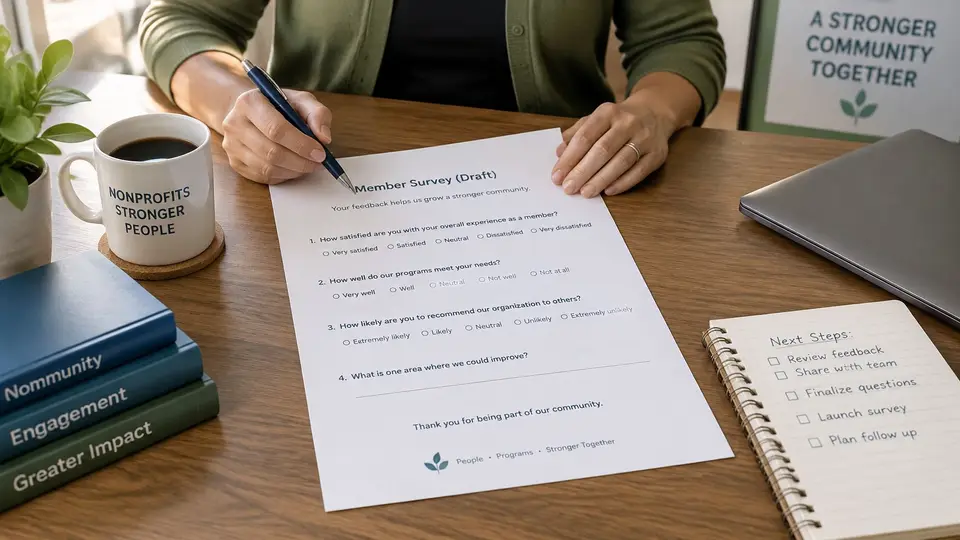
Habits that make answers interpretable
- Separate concepts. A combined rating for events and communication can't reveal which needs attention. Each topic needs its own question.
- Define the recall period. A benefit-use question should specify a period, such as the past 12 months, rather than leaving members to choose their own timeframe.
- Balance evaluative scales. Satisfaction scales need equally clear positive and negative choices, with a neutral midpoint. A usefulness scale can instead run from no usefulness to high usefulness.
- Allow uncertainty. Not sure and Not applicable shouldn't be treated as interchangeable. The former signals uncertainty; the latter means the question doesn't fit the respondent.
- Replace internal jargon. Engagement might mean event attendance to a committee and reading email to a member. Asking about the actual behavior removes that ambiguity.
Broad overall satisfaction belongs after the specific experience questions, while the opening value questions establish the member's general assessment before detailed prompts. Staff shouldn't move the overall satisfaction question to the beginning because it seems important.
Practical rule: A response should identify an experience, not measure how willing a member is to agree with staff.
Long grids deserve particular scrutiny. Separate questions are preferable when a grid requires excessive scrolling or makes response labels difficult to follow on a phone.
Demographic questions should remain optional and serve a defined reporting purpose. If age, income, or another personal detail won't change a decision, it doesn't belong in the form.
Before approval, a staff member should read each question aloud and check whether the same answer could mean different things. Low satisfaction with contact frequency, for example, requires follow-up to distinguish too many messages from too few.
How to Pilot the Survey Before Members See It
A question that looks clear to staff can mean something different to a member. Pilot testing gives the coordinator a chance to catch those differences before distributing the final questionnaire.
The Handbook of Question Design supports clear wording, focused questions, and short questionnaires. The pilot should test both interpretation and the experience of completing the form.
A practical testing sequence
Recruit a small, varied group. A practical pilot could include five to eight members across membership types, participation levels, and comfort with online forms. A reachable lapsed member can help test a separate nonrenewal version, rather than answering current-member questions that no longer fit.
Ask participants to explain the questions. Each participant should read the prompts aloud and describe what they mean in their own words. The coordinator should record pauses, requests for clarification, and unexpected interpretations without coaching participants toward an answer.
Revise ambiguous terms. Words such as value, community, and engagement deserve attention when participants interpret them differently. Questions about concrete experiences may be more useful than abstract language.
Run a soft launch. A small group from the intended recipient list should complete the revised form normally. The coordinator should inspect completion time, skipped questions, and breakoffs, meaning places where participants stop before finishing.
Check repetitive response patterns. Straight-lining means selecting the same answer throughout a grid. It isn't automatically careless responding, but confusing labels or long grids should be investigated when that pattern appears.
Lock and save the final version. The coordinator should archive the questions, answer labels, display order, and form settings. Material revisions after a soft launch may require keeping those early responses separate.
A clean pilot produces reasonably consistent completion times, few unexplained skipped answers, and no unresolved comments about confusing questions.
If staff combine related questions into a single score, a qualified analyst should check whether those questions work consistently together. Reliability isn't proof of validity: consistent answers don't necessarily mean the score measures the intended concept.
Separate value, event, and renewal questions shouldn't be combined into a single score merely because the form tool makes averaging easy.
How to Send the Survey to Every Member Group
Distribution starts with the member database, not the latest event registration list. Inviting only recent attendees or regular email readers excludes people whose membership experience may be very different.
A defined member list, planned follow-up contacts, and checks against known member characteristics provide a stronger foundation than an unrestricted public link, as discussed in survey methodology guidance on response and nonresponse.

Clean the invitation list. Remove duplicate records so each person receives the intended invitation. Shared household contact details need review rather than automatic deletion.
Identify member groups. Tag current and lapsed status, volunteer roles, and membership levels/types. These categories can overlap, so volunteers shouldn't automatically become a separate, mutually exclusive membership status.
Choose the invitation approach. A census invites every eligible member and is often simpler for a small organization. A stratified random sample selects members randomly within defined groups, rather than relying on whoever happens to respond.
Offer usable channels. Options include email links, agreed-to text messages, event QR codes, and printed copies for members without email. Event-based collection should supplement outreach, not replace contact with nonattendees.
Schedule contacts and a close date. Send advance notice, the invitation, a personalized reminder, and a final follow-up through another permitted channel. Suppress reminders to completed respondents when completion tracking allows it; don't promise anonymity if tracking identifies answers.
Keep separate counts. Record invited, delivered, started, and completed counts by group. Any reported response share needs an explicit denominator, not an unexplained percentage.
A copyable invitation
Subject line: Share your feedback in a few minutes
Hello [First name], we want to hear how membership is working for you. The survey takes about [number] minutes, and your answers will help us plan programs, communication and events. Thank you, [Name], [Title].
The invitation should also include the survey link and closing date. Lapsed members should receive a separate version focused on nonrenewal, without a future-renewal question that assumes active membership.
Turn Survey Results Into Actions With Owners
The survey closes and the results arrive as a stack of numbers: an average value score, a satisfaction rating, a page of open-text comments. Averaging them into one figure feels efficient. It also hides the thing you need most, which is who said what.
Start by counting responses by group, comparing respondents with the full membership, and flagging the least-represented groups. Membership type, tenure, and renewal status give useful comparisons when you can collect them without contradicting the privacy promise. Then read the results by segment.
An overall score behaves like a restaurant rating that mixes a weekday lunch crowd with a Saturday dinner crowd. The average is arithmetically correct and practically useless. A segment view shows which table is unhappy.
Survey result patterns, likely meanings and first actions
Treat each pattern as a question to investigate. The owner column is what separates a survey that changes something from a score report nobody acts on.
| Result pattern | Likely meaning | First action | Owner |
|---|---|---|---|
| High value score with low renewal intent | Members may see value that does not match the renewal decision, or they may face cost pressure | Compare renewal reasons with benefit use before changing dues | Membership coordinator and treasurer |
| Benefits rated useful but rarely used | Members may not know a benefit exists or how to use it | Send a one-page benefit guide and check which benefits members use next year | Communications lead |
| Low event satisfaction among attendees | Format, timing or location may not match what members need | Ask attendees for preferred formats and times in the next event survey | Events committee |
| Low communication satisfaction | Updates may be too frequent or too rare for some groups | Test a different schedule with one member group for one quarter | Communications lead |
| Dues amount given as the top renewal reason | Price concern, weak perceived value, or both | Review benefit use and renewal reasons together before any dues decision | Board and treasurer |
| Respondents mostly active members | Results may overstate satisfaction | Follow up with lapsed and nonresponding members through another channel | Membership coordinator |
The benefits row needs careful interpretation: the usefulness question measures benefits members have used, while the selection question identifies which benefits they used. Those answers don't establish whether unused benefits are attractive, unfamiliar, or irrelevant. A benefit nobody uses may be one nobody knows about.
Give comments a consistent review process
Tag open-text comments with themes such as event timing, unclear benefits, or renewal friction, then count how often each appears. A comment can carry multiple tags when it covers distinct issues.
- Preserve context. Quote a representative comment to illustrate a theme, and keep the response counts beside it so readers see how common the theme was.
- Protect identities. Omit identifying details from quoted comments and follow the privacy approach you promised in the invitation.
- Restrict access. Limit individual responses to staff who need them. Role-based permissions, where access follows a person's role, keep that boundary easy to maintain after the survey is done.
The board summary should fit on a page and include three proposed actions, each with an owner and target date. Name the gaps in representation alongside them so board members understand where further outreach is needed.
Choose Your First Follow-Up Action Now
Start with the result pattern that has the clearest connection to renewals or event attendance, rather than the lowest rating alone. High value paired with low renewal intent, for example, warrants a closer look at reasons for leaving before the board changes membership dues.
A named owner turns a survey finding into a task someone can finish and report back on.
For updates, describe only changes that are funded and scheduled. After an event schedule change is in place, an update could read: Members reported that event times didn't fit their schedules. Starting next quarter, the association is offering an additional evening session.
The annual survey should retain its core wording, with any distribution changes documented. Group-level comparisons are more useful than celebrating a small overall shift without checking who answered.
Write the action record with the issue, the responsible person, the deadline, and the evidence of completion. For example: Membership coordinator, by the end of next quarter: review renewal reasons alongside benefit use and recommend a targeted response to the board.