
How to Manage Membership Cancellations for Clubs
Learn how to manage membership cancellations for US clubs and associations: acknowledge the request, check policy, update status, and handle dues.

Managing a membership cancellation comes down to five moves, in this order: acknowledge the request in writing, check the written policy for that membership level, update the member's status and communication preferences, coordinate any outstanding dues and bookings, and only then ask for one optional reason. Give each move a named owner and a timestamp, and the record closes cleanly whether or not the member ever comes back.
The request rarely arrives in a tidy form. A member leaves a voicemail on Thursday afternoon saying she's relocating to Denver in June and wants to know whether the dues that drafted on Tuesday come back. Someone forwards the message to the treasurer. The treasurer forwards it to the membership coordinator. The renewal reminder goes out the following week anyway. Nobody did anything careless. The request had no path through the organization.
A cancellation needs three things: a place to land, a person who owns it, and a written trail. This walkthrough is for US clubs, associations, and membership-based nonprofits that bill dues and answer to a board. It doesn't cover canceling a streaming service, a software plan, or a personal app subscription. The aim throughout is an accurate member record, not a last-minute pitch to keep someone in a membership they've decided to leave.
What Managing a Membership Cancellation Covers
Members carry expectations over from the consumer world. Forrester's 2025 consumer research found that 41% of U.S. online adults said subscriptions were too difficult to cancel. A club answers that expectation with a narrow job: make the exit findable, confirmable, and fast.
The member record works like a handoff log. Every step leaves a dated entry naming who did what, so the file shows a clean status change whether the member comes back or not. Three roles usually touch it, and naming them up front prevents the gap where everyone assumes someone else replied:
- Whoever opens the message, often the front desk or a volunteer monitoring the inbox, logs it in the member record the same business day.
- Whoever has billing access, usually the treasurer, reviews open balances and payment status that week.
- The membership coordinator updates the member database and turns off the reminders tied to the canceled membership.
On a small board, one person may wear two of those hats. That works, as long as the record shows which hat was worn and when.
Save attempts and refund promises sit outside this scope. The workflow below covers what stays in: nine steps from request to filed confirmation, a handoff table for the checks before a record closes, and an acknowledgment email a coordinator can copy and send today.
Process a Membership Cancellation From Request to Filed Confirmation
Start with the written trail. The confirmation message below is the artifact the file is built around, and every step that follows produces something that belongs on the member record.
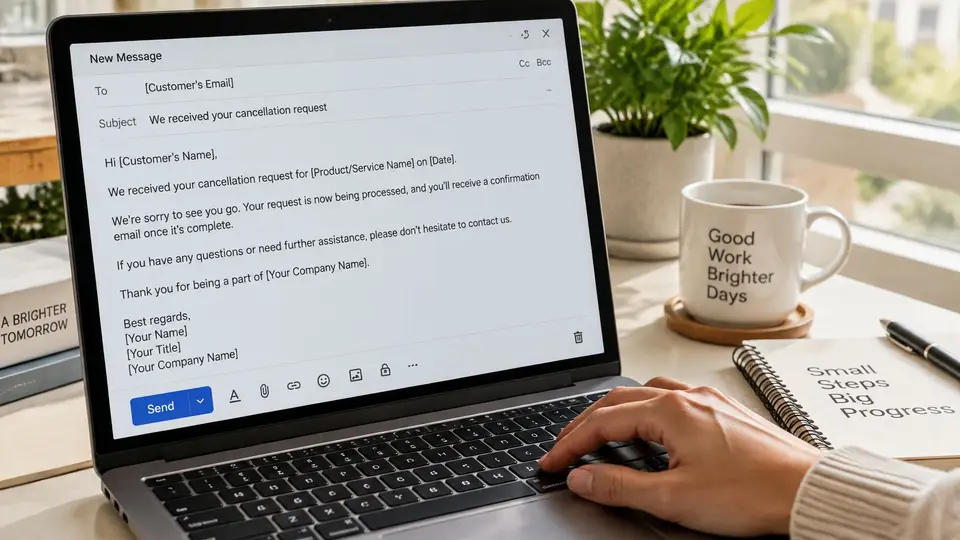
Work the steps in order. Each one names an owner and a timing, so a request that arrives on a Friday doesn't sit until the next board meeting.
Log the request, acknowledge it, and read the policy
1. Confirm who is asking. The membership coordinator checks that the requester is the member or an authorized household or organizational contact. Then log the member name, member ID, the channel it came through, the date, and the time zone it arrived in. A request emailed at 9 a.m. Eastern Time is 6 a.m. Pacific, and knowing which clock applies keeps the reply deadline honest. The FTC's business guidance on its Click-to-Cancel rule describes the expectation plainly: an organization shouldn't require a member to speak with a live or virtual representative to cancel if a representative wasn't required to enroll. If someone joined through a form, they should be able to leave without a phone call.
2. Acknowledge in writing the same business day. The person who opened the message sends a short reply naming a staff owner. The outcome doesn't have to be decided yet. What matters is that the member knows a human has it, and the record has a timestamp.
3. Read the written policy for that membership level. The membership coordinator checks the renewal date, any published notice language, and the effective date the policy supports, before touching the status. Specificity matters here. New York's rules for health clubs, for instance, give members a three-day window after signing to cancel and require a refund within 10 business days for qualifying cancellations, as the New York Attorney General's health club guidance lays out. Whatever the organization's own policy says, quote it accurately rather than improvising a date.
4. Run the handoff checks before anything changes. The table below lists what each owner confirms, and in what order.
Cancellation checks before the record is closed
| Check | What to confirm | Owner | Timing |
|---|---|---|---|
| Policy fit | Membership level, renewal date, published notice language and the effective date | Membership coordinator | Before the status change |
| Outstanding dues | Open invoices, payment status, returned online payments and any real balance | Treasurer or billing owner | Before future dues notices stop |
| Benefits and bookings | Event registration, classes, space bookings and member portal access | Events or program owner | Same day as the status change |
| Communication preferences | Renewal reminders, newsletters, donation appeals and household contacts who remain | Communications owner | With the status update |
| Optional feedback | One reason after confirmation, never a required survey that blocks the exit | Membership coordinator | After the acknowledgment |
Close dues, bookings, and status in the right order
5. Have the treasurer review open invoices and payment status. Stop future dues notices for that membership. If a real balance exists, name it accurately. Say a member owes $40 for a specific program fee: label it as an unpaid program fee, not a standard dues balance, so the next treasurer doesn't chase the wrong line. The reply says the treasurer will follow up on the balance. It doesn't promise a refund and it doesn't threaten a fee.
6. Check event registrations and bookings. The events or program owner confirms that a paid class, dinner, or space booking isn't dropped and isn't billed a second time. A member who cancels her membership but keeps a paid banquet seat has two separate records, and both need to be right.
7. Mark the person canceled or former as of the effective date. The membership coordinator updates the database, stops renewal reminders and newsletters for that membership, and keeps the transactional history intact. The history is what makes a later return a two-minute job instead of a rebuild.
8. Confirm the exit in writing and file it. Send the closing message, state which access ends and when, and save the acknowledgment thread to the member record. A note that says only "canceled" will not answer a board question in November.
9. Ask for one reason, after the exit is complete. Offer a short list, such as cost, low use, a move, or a temporary break. A reply is optional, and the cancellation is already processed. Asking before confirmation turns a courtesy into an obstacle.
Acknowledgement Email You Can Send
Copy the message below and replace every bracketed field. It's written for a fictional organization, Riverbend Community Club, so the tone stays concrete as you adapt it.

Subject: We received your membership cancellation request
Hi [member first name],
Thanks for letting us know. This confirms that Riverbend Community Club received your cancellation request for your [household / individual] membership on [date received], and that [staff name] is handling it.
Based on our membership policy, your cancellation takes effect on [effective date]. Future membership dues notices for this membership will stop as of that date.
[If applicable] There's an open balance of $40 for the [program name] program fee. [Treasurer name] will follow up separately about that.
Your registration for [event name] on [event date] is already paid and remains available to you. Member portal access for this membership ends on [effective date].
If you have a minute, a one-line reply about why you're leaving helps us plan. Cost, schedule, a move, and a temporary break are the reasons we hear most often. A reply isn't required, and your cancellation is processed either way.
You can reach the office at [phone number] or through the member portal at [contact path].
Thanks for your time with us, [Name], Membership Coordinator Riverbend Community Club
A short version for a phone or front-desk request
When someone cancels in person or by phone, send the same facts in writing before the end of the day. "Hi [name], this confirms your call to the Riverbend front desk on [date] at [time] Eastern Time. Your request to cancel your [level] membership is logged, [staff name] is handling it, and under our policy the cancellation takes effect on [effective date]. Future dues notices stop as of that date. Your paid registration for [event] stays as it is. We'll send a final note if anything in the record changes."
Phrases to leave out
Three sentences create more work than they save. "Your refund has been issued" belongs in a message only after the treasurer has processed one. "A cancellation fee will apply" should appear only if the written policy states that fee for that membership level. And "our payment processor has already reversed the charge" describes a system the organization doesn't control, so staff should confirm the payment status and report what they see.
Handle Household, Billing and Pause Exceptions
Requests that involve a household seat, an organizational seat, or a failed payment usually need one extra check before anything changes. The records that get damaged are the ones where someone updates more of the account than the member asked for.
- Household memberships. Cancel only the person who asked. If the partner stays on as a member, the family record and the payer relationship stay exactly as they are. A joint event booking belongs to whoever is still attending, so leave it untouched and note on the record why it stayed.
- Organizational memberships. Confirm which seat or named contact is leaving before touching the account. One departing employee can strand the remaining seats if the whole record gets closed. If that person was also the payer, move the payer role to a staying contact first so dues keep landing with the right party.
- A returned online payment. A message reporting a failed payment is a billing correction. Fix the payment status, send a payment link for the outstanding balance, and leave the membership active. Recording these as cancellations hides the underlying problem and inflates your exit count.
- Pauses and seasonal status. Offer a pause only when your written policy includes one, show it before confirmation, and keep the cancel path visible the whole time. The offer is worth making because timing drives a large share of exits: in a survey of 2,500 U.S. adults reported by Business Insider, 40% said they had wanted to keep a subscription but canceled because they couldn't pause it or move to a free option.
For the board handover: every exception note should name the effective date, the person who acknowledged the request, and whether reminders were turned off. A successor treasurer who can't see those three things will eventually bill a former member, and that conversation is always worse than the note would have been.
Confirm the Record Is Complete
Treat the closed record like a file a brand-new treasurer can audit cold. If they open it six months later, they should see why the membership ended, which rule produced the date, and why no dues or reminders are still running.
Use this last check before you call it done:
- Source and policy: the request channel and date are attached, and the effective date cites the policy level that governed it.
- Status trail: active status, end date, communication preferences, and linked household or organizational records show one consistent final state.
- Money and bookings: every invoice, refund, payment link, waitlist entry, and reservation is closed, transferred, or assigned to a named owner.
- Exceptions: a pause, seat change, or returned payment carries a short note with the decision and approver.
- Proof out: the member received the outcome in writing, and a copy sits on the record.
Former members can remain contacts so history and rejoining stay simple, while active-member billing stops. campai keeps member records, dues, reminders, and the member app in one place, with reminders following the organization's settings.