
Membership Renewal Letter Templates and Send Timing
Copy membership renewal letter templates for advance, due-date and overdue notices, with timing, subject lines and placeholders for US clubs and associations.

The renewal list is ready, but some members have already paid, others have different expiration dates, and the draft email mixes annual dues with a donation request. A useful membership renewal letter resolves those details before it reaches the member: the amount owed, the due date, the payment link, and a person who can help.
For a club or association membership coordinator, the practical starting point is three reusable letters tied to dates in the member record: an advance reminder, a due-date reminder, and a courteous overdue follow-up. Keep annual dues visibly separate from voluntary gifts, and stop reminders when payment is confirmed.
Three Renewal Letters You Can Copy
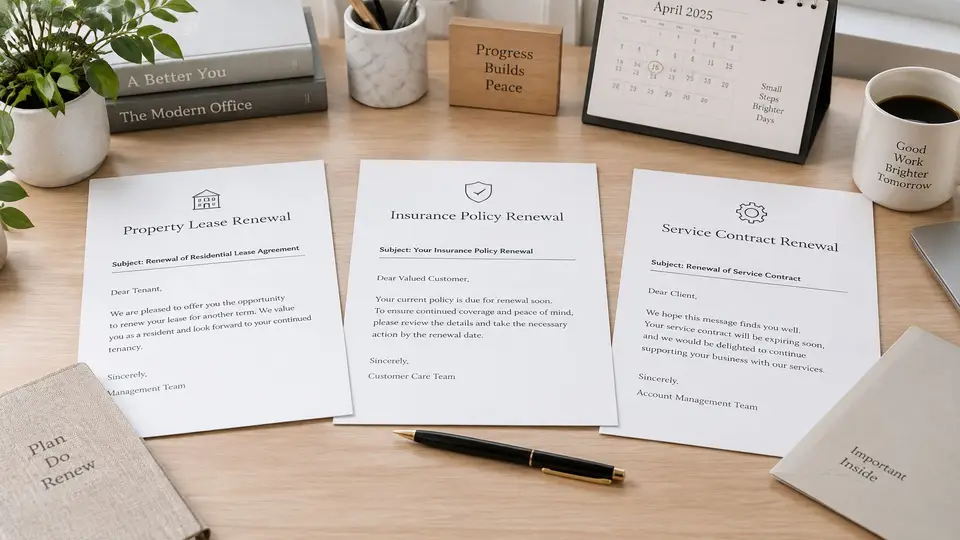
When one member renews on a fixed annual date and another on their join-date anniversary, the letters need different dates but the same clear structure. A renewal cycle that encompasses the full process uses three letters: an advance reminder, a due-date reminder, and a courteous overdue follow-up. Each one should match the member's status in the record.
Advance reminder
Use this version about 60 days before the due date as a working schedule. It can serve as an email or a printed letter. Use the subject line listed in the table below.
Dear [Member Name],
Thank you for being a [Membership Level] member of [Organization Name]. Your annual membership dues of [Dues Amount] are due on [Due Date].
You can pay online at [Payment Link].
If you have a question, reply to this email or contact [Contact Name] at [Contact Email].
Thank you for being part of [Organization Name].
Sincerely, [Contact Name]
[Role], [Organization Name]
For printed correspondence, replace “reply to this email” with “contact the membership team.” Print the full payment address so members can use it without a link.
Due-date reminder
Send this version on the due date, after removing members whose payment has posted. Keep the access sentence only if it matches the organization's membership policy.
Dear [Member Name],
Your [Organization Name] membership dues of [Dues Amount] are due today, [Due Date].
You can pay at [Payment Link]. Your access continues once your payment posts.
Questions? Contact [Contact Name] at [Contact Email].
Thank you, [Contact Name]
[Role], [Organization Name]
If benefits remain active during a grace period, replace the access sentence with the actual continuation date. That keeps the reminder accurate without suggesting access ends immediately.
Courteous overdue follow-up
Send this letter after the organization's grace period ends. Confirm the status and offer help without assigning blame. Use the overdue subject line in the table below.
Dear [Member Name],
Our records do not yet show payment of your membership dues of [Dues Amount], due on [Due Date].
If you have already paid, please disregard this message. If you need help with payment or something has changed, reply or contact [Contact Name] at [Contact Email].
You can pay at [Payment Link].
Thank you, [Contact Name]
[Role], [Organization Name]
Hypothetical USD examples: “Your annual membership dues of $85 USD are due on [Due Date].” For a different membership level, use the same sentence with “$120 USD.”
Before sending, map each placeholder to a member database field, including membership level, dues amount, due date, and payment link. Assign an owner to shared contact details so questions reach the right person.
Keeping Annual Dues Separate From Donations
Annual dues are membership payments. Donations are voluntary gifts. A member shouldn't have to work out which amount renews membership and which amount supports an additional fundraising request.
Place the dues information first. Name the membership level and current term so the payment has an unmistakable purpose, especially when the organization also collects event registration payments or program fees.
Annual dues compared with donations
| Feature | Annual dues | Donation |
|---|---|---|
| What it pays for | The current membership term and member benefits | Organization programs and general support |
| Who sets the amount | Set by membership level and type | Chosen by the member |
| Effect on renewal status | Required to renew | Optional and does not change renewal status |
The main payment block can stay short:
Your annual dues for [Membership Level] are [Dues Amount], due on [Due Date]. You can pay at [Payment Link].
If a donation request belongs in the same communication, place it afterward in its own paragraph. It shouldn't interrupt the dues amount, deadline, or renewal instructions.
Your renewal does not depend on a gift. If you would like to support [Organization Name] programs, you may make a separate donation at [Donation Link].
Avoid a combined total labeled “renewal contribution.” That wording leaves members uncertain whether a gift is required or whether the full amount purchases membership.
Check the wording against the records
The treasurer should confirm how financial records distinguish dues from donations. The membership coordinator should then read the letter from the member's perspective, checking whether the required payment and optional gift are easy to tell apart.
A useful final check is whether someone can identify the renewal amount without reading the fundraising paragraph. If not, move the donation request farther down or leave it for a separate communication.
Subject Lines and Tone for Each Stage
A member opens the renewal email on a phone and sees only the subject line and preheader. Put the organization's recognizable name and the message's purpose up front; keep the renewal date visible when space allows.
| Stage | Primary subject line | Alternative |
|---|---|---|
| Advance reminder | [Organization Name]: renewal details for [Membership Level] | A quick look at your upcoming membership renewal |
| Due-date reminder | Action needed: complete your [Organization Name] renewal | Your renewal payment options |
| Overdue follow-up | Need help with your [Organization Name] renewal? | Checking in about your membership |
Long organization names can push key details out of view on a phone. If the organization has an approved short name, use it consistently in the subject and spell out the full name in the message.
Let the preheader carry supporting detail
Use the preheader to add one useful detail, such as: “Annual dues of [Dues Amount], payment link inside.” Keep the subject and preheader complementary rather than repeating the same wording.
The tone should fit the member's stage:
- Advance reminder: Friendly and plain, with brief context about the upcoming renewal.
- Due-date reminder: Direct and concise, with the action near the top.
- Overdue follow-up: Courteous and patient, with an invitation to ask about payment or changed circumstances.
Treat a missed renewal date as a prompt to check the record and offer help. Keep the wording consistent with the organization's membership policy. Avoid all-caps subjects, exclamation points in overdue notices, and unsupported penalties. Do not label a routine follow-up “Final warning” if another reminder is scheduled.
For a simple subject-line exercise, ask volunteers to read several options once. Ask them to name the purpose of each subject line after one read.
Segmenting Members Before You Send
Segmentation starts with fields in the member database, not a coordinator's memory. Useful fields include join date, completed membership terms, membership level/type, expiration date, payment status, communication preference, and recorded participation.
A segment should change the message or the follow-up. Creating labels without changing either only adds administrative work.
Match the message to the membership history
First-year members need a benefit-focused message grounded in their actual record. A coordinator can filter for members approaching their first renewal, then name a relevant resource, onboarding page, or staff contact.
An example addition is: “For help getting started with [Member Resource], contact [Contact Name] at [Contact Email].” Avoid claiming that a member hasn't used a benefit unless the organization reliably records that activity.
Long-tenured members generally don't need introductory explanations of the organization. Filter by completed membership terms and active status, then use a concise value recap alongside the payment prompt.
Lapsed members need a low-pressure choice rather than another ordinary invoice. Their message can invite them to renew, update communication preferences, or explain why they left, with a named coordinator responsible for reviewing replies.
A member who reports that the program no longer fits needs a conversation about relevance, not another copy of the same reminder.
Use cycle and channel fields operationally
For fixed annual renewals, eligible members can enter the same batch. Anniversary-based renewals require individual send dates calculated from each member's expiration date, so the coordinator maintains a continuing queue rather than a single annual mailing.
Channel selection should follow recorded preferences:
- Email preference: Use a monitored reply address and the member's current email.
- Mail preference or missing email: Prepare a printed letter with a usable payment address and contact information.
- Uncertain contact details: Resolve missing or conflicting information before adding the member to the send list.
Save the segment name with the campaign record. That makes later comparisons possible without reconstructing who received which version.
When to Send Each Renewal Letter
Example renewal send schedule
| Touch | Timing | Message focus | Owner |
|---|---|---|---|
| Value letter or email | About 90 days before expiration | Benefits recap and renewal date | Membership coordinator |
| Reminder | About 60 days before expiration | Dues amount and payment link | Membership coordinator |
| Reminder | About 30 days before expiration | Payment options and reply contact | Membership coordinator |
| Reminder | About 7 days before expiration | Final reminder with the exact due date | Membership coordinator |
| Final notice | On the renewal date | Dues due today and access continues once payment posts, if consistent with policy | Membership coordinator |
| Overdue follow-up | 14 days after the due date, an example only when the grace period has ended | Courteous lapse notice and help options | Treasurer or membership coordinator |
The pre-expiration sequence follows the practical timing described in this membership renewal workflow guide: approximately 90, 60, 30, and 7 days before expiration, followed by a renewal-date notice. The overdue timing in the table is a hypothetical operating example, not a recommended grace-period policy.
The core letters don't require entirely new copy at every touch. The advance letter can become a shorter reminder as the deadline approaches, while the earliest value message can emphasize a relevant member benefit rather than repeat the full billing notice.
Anchor every send to the member record
The coordinator should confirm whether the dues due date and membership expiration date are the same. If they aren't, the template needs separate fields and wording that makes the distinction clear.
The grace-period end date also needs an explicit value. A follow-up shouldn't describe membership as lapsed while the organization's policy still treats it as active.
Use email for most touches and printed correspondence for members who prefer mail or lack an email address. Repeating every message through every channel isn't automatically useful, especially when the member has already replied or asked for assistance.
Adjust the workload before the deadline
A fixed-date cycle creates concentrated preparation and reply handling. An anniversary cycle spreads the work across the calendar but requires regular attention to the next eligible group.
If members commonly need extended lead time to arrange payment, move the initial notice earlier. If a member has already confirmed a payment issue with staff, pause generic reminders while the assigned person resolves it.
Copy the schedule into a shared calendar, assign one accountable owner per row, and confirm that the payment link works before each send date. Refresh the eligible list immediately before sending so paid members don't remain in the queue.
How to Follow Up With Overdue Members
A courteous overdue process begins with verification. Staff should establish what happened before asking the member to pay again, particularly when payment records and correspondence are handled by different people.
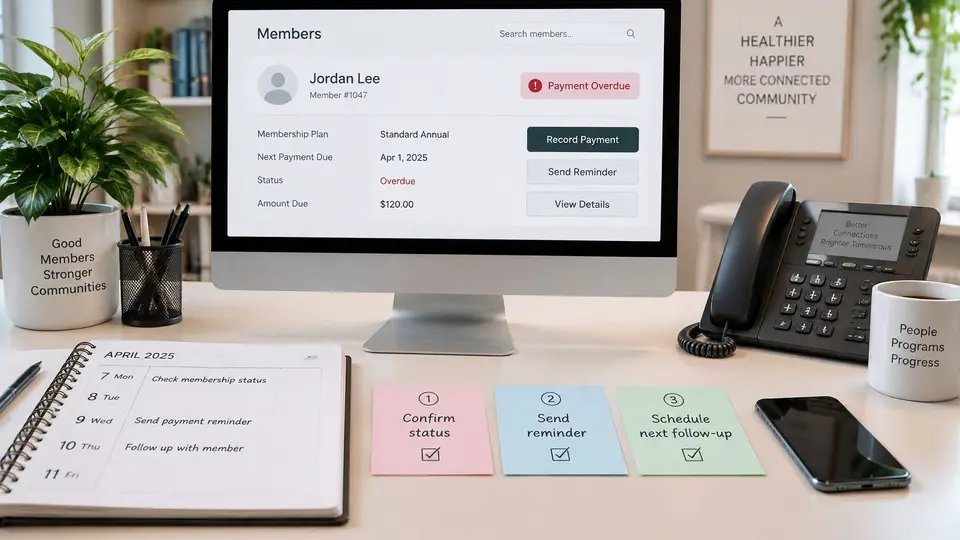
A practical overdue procedure
Confirm payment status. Review the member record, including pending activity and any returned online payments. This prevents an unnecessary demand when payment has arrived but hasn't yet been matched to the membership.
Check the grace period. Confirm the policy and its end date before sending the post-grace-period letter. A member still within that window shouldn't receive wording that incorrectly declares a lapse.
Send the courteous follow-up. Include the dues amount in USD, original due date, payment link, and a monitored reply option. These details let the member act without searching through earlier messages.
Assign personal outreach when needed. As an example operating rule, a coordinator might send a personal note or arrange a call after about a week without a response. The named staff member or volunteer should ask whether help is needed rather than recite the entire overdue letter.
Log the result and next action. Record the contact date, response, responsible person, and next follow-up date. A brief factual note helps another administrator continue the work without repeating the same questions.
Confirm the benefit end date in writing. When the lapse date passes, state exactly when applicable benefits end, following organizational policy. Name affected items, such as event pricing, voting rights, or member portal access, rather than using a vague reference to privileges.
Handle hardship privately
A member facing financial hardship needs a direct contact route, not a public explanation or an improvised promise. Staff should review available options under the organization's policy and avoid offering discounts or payment arrangements without authorization.
A healthy overdue queue has one owner, one next date, and one clear message for each lapsed member. Records should also distinguish an unanswered reminder from an explicit decision not to renew.
Pre-Send Checklist, Pilot Send and Evaluation
Check the essentials
Before sending, confirm that each detail matches the member record and the renewal stage.
- Merge fields: Map placeholders to member database fields, then check sample records for different membership situations.
- Membership cycle: Confirm that the due date matches the segment's fixed or anniversary-based cycle.
- Dues amount: Match the USD amount to the correct membership level and renewal term.
- Payment destination: Open the payment link and check the payment process in an appropriate test environment.
- Separate donation request: Keep any voluntary gift request distinct from required dues, with each amount clearly labeled.
- Sender identity: Set a recognizable sender name and a monitored reply address.
- Audience: Confirm that each segment receives the letter intended for its renewal stage.
Send a test copy to a staff inbox. Review the rendered message for missing fields, spacing, and an unclear payment action.
Pilot the workflow, not just the wording
For a hypothetical pilot, select members due within the next 60 days, send the advance letter, and review activity over two weeks. Keep the cohort identifiable so the coordinator can connect replies and payments to the correct send.
Track replies, payment starts where observable, posted payments, returned online payments, and bounced emails. Compare results by segment and channel. This helps identify whether a problem lies in delivery, payment instructions, or the member's decision not to renew.
Count a payment start as pending until the payment posts, and check silent members before the due-date send. Revise the part of the process that needs attention, such as contact details, wording, payment instructions, or reply handling.
campai connects member records, dues and billing, online payments, communication, and member self-service in membership management software. These connected records can help coordinators follow renewals without reconciling separate lists.