
How to Increase Association Membership in 2026
Learn how to increase association membership with a small-team plan for audience, value, outreach, referrals, applications, and conversion tracking.

The board wants more members, the coordinator has a list of event guests, and another invitation is waiting for approval. Yet the message still says little beyond join the association. How to increase association membership starts with a clearer offer, not a bigger mailing list: recruit one defined audience around a useful outcome, then give each prospect a straightforward path to joining.
For a small US professional or trade association, a focused recruiting cycle is more manageable than an open-ended growth campaign. The proposed 90-day plan below assigns owners, supplies invitation copy, and separates interest from completed memberships. It measures acquisition, while onboarding and member retention remain separate responsibilities.
Choose Who to Recruit and Why
An association increases membership by recruiting one defined audience with one outcome prospects can use soon. Asking practitioners, employers, early-career professionals, and suppliers to join for the same reason produces an offer that's hard for any of them to recognize as relevant.
The membership coordinator should select the segment before drafting outreach. The executive director should approve both the audience and the benefit the association can deliver. A benefit belongs in the campaign only when staff can show something concrete before requesting membership dues.

Who to recruit and the reason to join
| Audience | Outcome to promise | Proof to show | Best source of names |
|---|---|---|---|
| Individual practitioner | Peer access and practical professional tools | A dated program or member-only briefing | Current member referral |
| Employer or company member | Staff development and organizational visibility | Group enrollment or a committee seat | Board or vendor introduction |
| Early-career professional | Mentoring and a first network | A mentor match or new-member orientation | Volunteer or campus contact |
| Allied supplier | Buyer access and standards updates | An exhibitor or briefing invitation | Introduction from an existing member |
These are offer options, not promises every association can make. A committee seat requires an actual opening and the appropriate selection process. Supplier participation shouldn't imply guaranteed introductions to buyers or access to private member information.
Write a value sentence the board can repeat
The sentence should identify who qualifies, what becomes useful, and when participation can begin. Broad statements about supporting the profession can complement the offer, but they shouldn't replace it.
A hypothetical plumbing trade association might use this sentence:
Independent plumbing contractors can attend the upcoming pricing and permits briefing, review a practical estimating worksheet, and learn about the open standards committee application process.
The coordinator should check the program date, resource availability, and committee opening before anyone forwards that sentence. If the proof isn't ready, the offer isn't ready.
Membership dues are membership payments and should match a published membership level. Donations are voluntary gifts and don't belong in this recruiting ask. The campaign should also distinguish individual membership from company membership so prospects understand who receives access.
For the proposed cycle, the director should approve one primary segment and park the others. That constraint gives staff a fair opportunity to evaluate a specific offer instead of mixing unrelated audiences and calling the result a growth campaign.
Run a 90-Day Recruiting Plan
A small team doesn't need a campaign department. It needs a working calendar, a named list, and someone responsible for the next conversation. The schedule below is a proposed operating plan, not an industry benchmark or a promise of growth.
The membership coordinator owns the list and application follow-up. A board member supplies introductions and credibility. A volunteer hosts the preview, while the executive director resolves offer questions and reviews the result.
90-day recruiting plan for a small team
| When | Owner | Action | Done when |
|---|---|---|---|
| Week 1 | Membership coordinator | Lock one audience and one proof point | Value sentence approved by the director |
| Week 1 | Coordinator and board member | Build 40 to 60 named prospects with sources | Every row has a source and an owner |
| Weeks 2–6 | Board member and coordinator | Send invitations in batches of 10 to 15 | Each batch has a reply date |
| Weeks 2–8 | Volunteer | Host one preview briefing or networking hour | Attendees are marked on the prospect list |
| Weeks 6–10 | Membership coordinator | Follow incomplete applications within five business days | Each stalled application has a status |
Build a list that can support follow-up
The suggested list size is a workload choice. Staff should use member referrals, recent event guests, exhibitors, and people who started but didn't finish membership applications, subject to the organization's communication preferences and permissions.
A name alone doesn't count as a workable prospect record. Each entry needs a source, an owner, a reason the person fits the audience, and a next step. For company membership, the record should also identify whether the contact can authorize membership or needs an employer's approval.
The coordinator should remove duplicates before invitations go out. Otherwise, a board member and staff member may contact the same person with different requests.
Practical rule: No invitation batch should exceed the team's capacity to answer replies before its stated reply date.
Small batches allow staff to discover confusing language before repeating it across the entire list. The owner should record questions in the prospect record rather than relying on an email inbox or a volunteer's memory.
Give the preview a narrow job
The preview should demonstrate the promised benefit, not deliver a long institutional presentation. In this proposed plan, a 45-minute virtual briefing or a networking hour gives prospects a bounded commitment and staff a clear attendance record.
The volunteer host should know what qualifies as success: attendees experience something relevant and leave knowing the next membership step. A board speech, a fundraising appeal, and unrelated announcements shouldn't crowd out that purpose.
At week 12, the coordinator and executive director should count invited prospects, attendees, applications, and approved or paid memberships. They should decide whether the segment merits another cycle, whether the offer needs revision, or whether the association lacks a credible benefit for that audience.
Completion means every name has a source, an owner, and a next step or final disposition. Adding another audience halfway through would make that review harder to interpret.
Invite Prospects and Ask Members to Refer
Direct invitations and member referrals should lead to the same offer, even though the opening sentence changes. Direct outreach explains why the person's role fits. A referral identifies the person who suggested the introduction, with permission.
The coordinator should write the invitation; the board member should personalize and send it where a relationship exists. That division keeps the offer consistent without making every message sound like a mass mailing.

Give the invitation one immediate purpose
The first invitation should ask for a preview registration or a reply, not a purchase, committee commitment, and referral at once. The subject line should name the preview, while the body connects the recipient's work to a specific outcome.
Staff should replace every placeholder before sending. The date, US time zone, host, and preview resource must be confirmed; the registration instruction must lead somewhere staff monitor.
The following hypothetical invitation can be adapted without adding an unverified testimonial or performance claim:
Subject: Invitation to the contractor pricing and permits preview
Hello [First name],
[Referring member's name] suggested this invitation because [Company] serves the independent plumbing contractor audience.
The association's upcoming briefing covers estimating questions and current permit resources relevant to independent contractors. The program includes a sample estimating worksheet and a discussion led by [confirmed program host and role].
The proposed session is [confirmed date], from 12:00 to 12:45 p.m. Eastern Time.
Registration is available through [insert the verified registration link], or a reply to this message can request a seat.
For anyone considering membership afterward, the Individual Practitioner membership level and published dues appear on [insert the verified membership application link].
[Coordinator name]
Membership Coordinator
[Association name]
The membership line supplies context without turning the preview into a hard sell. If the campaign targets employers instead, staff should replace the level and explain which employees receive participation rights.
Make the referral request easy to forward
A board member shouldn't ask current members to recruit anyone who might be interested. That transfers the hardest work, defining a suitable prospect, to someone without the campaign plan.
A shorter referral note can say:
Referral request
The association is inviting independent plumbing contractors to a pricing and permits preview. A suitable introduction would be an owner or operations manager who handles estimating or permit questions.
Please introduce one qualifying contact to [coordinator name]. Staff will send the details and handle follow-up.
The coordinator should provide a forwarding sentence alongside that request: The association has a practical briefing for independent plumbing contractors; [coordinator name] can share the program and registration details.
Each contact should retain a source such as referral, event guest, or direct invite. The full member database shouldn't receive the same recruiting note, and contacts who decline further outreach should be marked accordingly.
Answer Common Objections Before They Stall a Sign-Up
A prospect's concern needs a factual answer, not a stronger sales pitch. The coordinator should maintain a short answer library, with the executive director confirming dues language and program owners confirming benefit details.
Each answer should address the issue raised and offer an appropriate next step. Staff shouldn't assume that hesitation always means price, or promise benefits merely to keep the conversation going.
Prepare answers for cost, time, relevance, and worth
- Cost: State the published membership level and dues payment, including what the level covers. A sole practitioner shouldn't have to interpret a company membership offer, and staff shouldn't promise savings that the association can't document.
- Time: Offer the smallest useful commitment. For this plan, that can be the proposed 45-minute briefing, with its confirmed date and US time zone, rather than a vague invitation to become more involved.
- Relevance: Name the program or committee that addresses the prospect's question and identify its responsible member role. A committee chair can explain the work more credibly than a general list of benefits.
- Worth: Offer something inspectable before a decision, such as a member directory sample, program agenda, or resource preview. Staff should share only material appropriate for nonmembers.
The answer library should contain approved wording, not just topic labels. For example, a relevance response might state: The contractor program committee runs this briefing, and its chair has confirmed that estimating questions are on the agenda.
An unanswered concern isn't a reason to send the same invitation again.
Record the concern and the outcome
The coordinator should log the objection alongside the prospect's source and the resulting status: replied, moved to preview, awaiting employer approval, or declined with reason. That record lets another staff member continue the conversation without asking the prospect to repeat everything.
At the proposed week-12 review, the executive director should select the two most common objections and revise those answers before another batch goes out. If staff can't provide a convincing factual answer, the offer may need changing rather than better wording.
Make the Membership Application Easy to Finish
A prospect who starts an application has already shown intent. The coordinator should examine the joining process before assuming that a stalled applicant lost interest.
The review should follow the applicant's path, from choosing a membership type to receiving confirmation. Staff familiarity isn't a useful test: an internal label that seems obvious to the treasurer may mean nothing to a first-time applicant.
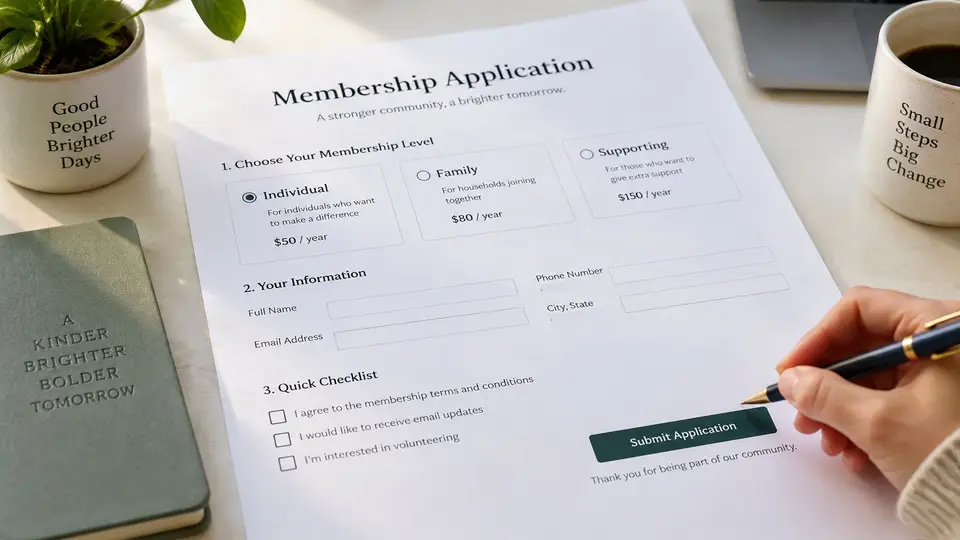
Remove decisions that applicants shouldn't have to guess
The first screen should explain membership levels in ordinary language, including who each level serves. Company membership should state whether the organization joins, which employees participate, and who becomes the main contact.
The form should then collect information staff will use:
- Identity and contact: Name, organization, role, and email.
- Membership selection: The appropriate level or type, with eligibility explained.
- Payment arrangements: The supported payment choice and any information needed to complete it.
- Required evidence: Documents essential to eligibility or approval, disclosed before the applicant begins.
Fields collected only because they might be useful someday should move to a later member profile update. Duplicate requests for the same organization or contact information should disappear.
Make approval and payment visible
When the process supports online payments or a payment link, the application should explain the next payment step clearly. Staff also need payment status so an approved applicant doesn't receive an inappropriate unpaid reminder or remain unnoticed after paying.
If board approval is required, the application should publish the association's actual business-day turnaround and identify who sends the decision. A required document shouldn't appear as a surprise after the applicant has completed the rest of the form.
Confirmation should name the welcome owner and the next scheduled event or orientation. Onboarding begins at that handoff; acquisition staff shouldn't treat the confirmation as a substitute for the separate welcome program.
Assign a recurring applicant test
Under this plan, the coordinator tests the form monthly with a clearly marked fake prospect record, then deletes the test record and excludes it from reporting. The test should cover level selection, required fields, supporting documents, confirmation, and payment instructions without creating a real charge.
A visible email contact should accompany the form; a phone or voicemail line shouldn't be the only support option. The coordinator owns replies to stuck applicants within the proposed five-business-day follow-up window and records whether the obstacle was resolved.
Track Conversion and Fix a Weak Cycle
The coordinator needs a stage report, not a total labeled interested people. The report should distinguish prospect, invited, replied or attended, application started, application submitted, and approved or paid.
ASAE's practical guide to the full member lifecycle recommends segmenting prospects, assigning a specific value proposition, and capturing source and conversion information in a shared member record. For this acquisition report, the coordinator should use that discipline without mixing recruiting outcomes with later renewal behavior.
Count completed joining consistently
The association should define the final stage according to its actual rules. If both approval and payment are required, an applicant isn't a completed member until both are recorded; approved but unpaid should remain a visible pending status.
For this campaign, an activated new member means someone who has finished joining. That label doesn't establish participation, engagement, or lasting membership, and it shouldn't be reported as evidence of retention.
The coordinator should update the list weekly and review it monthly with the executive director. Each stage total should remain separable by source and segment, with individual records available to explain outstanding next steps.
Where recruiting stalls and what to change
| What you see | Likely cause | Change before the next batch |
|---|---|---|
| List stays under the target | Segment is vague or no referral sentence | Rewrite the audience and ask each board member for one name |
| Invites get no replies | No date or no proof point | Add the preview time and one concrete benefit |
| Replies do not apply | Next step or level is unclear | Send one link and name the right membership level |
| Applications start and stop | Extra fields or a surprise document | Cut unused fields and warn about required evidence |
| Approved but unpaid | Payment sits outside the application | Put online payment or a payment link in the same follow-up |
Interpret the report before expanding outreach
These are diagnostic starting points, not confirmed explanations. Staff should inspect the affected records and replies before choosing a change.
A conversion calculation should name its starting and ending stages. Application-submitted-to-completed membership answers a different question from invited-to-completed membership; combining them under one conversion label makes the report ambiguous.
Referral contacts shouldn't be averaged together with cold names. If referrals progress more readily, the director can shift the next list toward introductions rather than authorize more cold outreach.
The report should exclude renewal rates, lapses, and cancellation reasons, which belong to the separate retention strategy. Keeping that boundary prevents a successful recruiting cycle from being mistaken for proof that total membership will grow sustainably.
Keep the Recruiting Path in One Member Record
A prospect who attends the preview, applies two weeks later, and pays online should look like one person the whole way through. When prospect lists, application forms, dues records, and event guest sheets live apart, staff reconcile the same name repeatedly and the owner loses the thread.
Membership management software, often called association management software (AMS) for associations, should preserve that continuity. Judge it by whether staff can follow a real joining process without rebuilding the record.
Keep the handoff visible
A workable record keeps the source, assigned owner, current stage, relevant messages, application status, and payment status together. Event registration should flag preview attendance on the same contact, and the first welcome task should already be attached when approval lands.
- Recruiting access: Board members and volunteers see the contact, the last touch, and the next follow-up they own.
- Approval responsibility: The designated reviewer gets the application and supporting evidence in one place.
- Welcome handoff: The onboarding owner sees that joining is complete and the next commitment is scheduled.
Set permissions from those responsibilities. Helpers get the records their follow-up requires, and the reviewer controls approval.
campai connects member records, dues, events, and communication so the team can follow a membership from application to renewal without piecing together spreadsheets and separate tools. Active members count toward the monthly price; contacts and former members do not, which lets a prospect list stay in the same system during the cycle.
Bring a real workflow to the setup conversation
Bring the segment definition, stage list, and a sample application. Ask for a free introductory call to talk through membership, imports, and setup, and have the setup work through one real example: membership types, dues rules, fields, payer relationships, and the workspaces the team needs.
Choose the system that shows the whole path on one record. No platform supplies the reason to join, and none answers the next prospect's question for the assigned owner.